
Section 5.1| Section 5.2 | Section 5.3
5.1 Standard Form, Mood and Figure
Syllogism: deductive argument consisting of two premises and a conclusion.
Categorical syllogism:
deductive argument consisting of three categorical propositions that is capable of being translated into standard form.
Parts of a Categorical Syllogism:
Terms:
Major Term: predicate of conclusion
Minor Term: subject of the conclusion
Middle Term: occurs once in each premise and does not occur in the conclusion
Premise Names:
Major Premise: top; one that contains the major term
Minor Premise: listed second; one that contains the minor term
Standard Form Rules
Note the need to rearrange arguments that are not in standard form.
Mood: letter names of proposition that make it up (A, E, I & O)
Figure: determined by the location of the middle term in the two premises that make it up
- Use the shirt collar model to memorize figure forms.
- NOTE: This method of determining figure is the best way to solve the problems that follow in the next two sections.
Unconditionally Valid Categorical Syllogisms
Explain what "unconditionally valid" means. This should be a review of Chapter 4 in that we also dealt with unconditionally valid syllogisms there also.
Aristotelian Additions
- The Aristotelian viewpoint is bound up with the existence of the objects referenced in the argument. Thus, these forms are contingent based on existence.
- Contrast the idea of unconditionally valid with conditionally valid.
Backwards Reconstruction of Arguments Given Mood & Figure
- We can build categorical syllogisms given only mood and figure information.
- The key here is remembering that deductive arguments, especially categorical syllogisms, are dependent on form for their validity rather that content (with the exception of the Aristotelian condition of existence).
5.2 Venn Diagrams
Venn Diagrams are on every major graduate school test known to man. Many of them have more than three variables, but we'll learn tricks to solve the most complicated of puzzles.
Review the method for drawing a basic Venn Diagram; note the seven areas that have to be visible.
The Diagram:
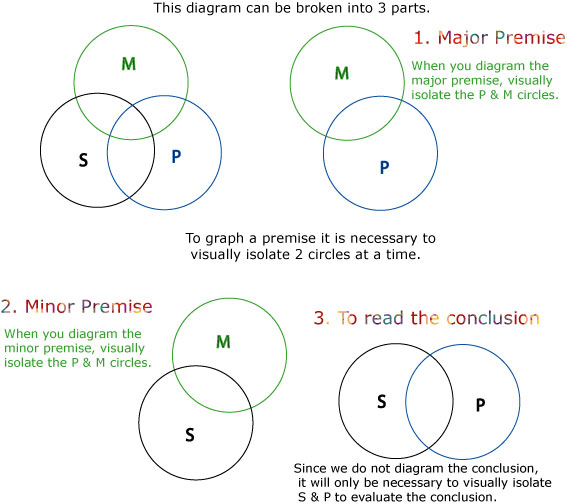
The Rules:
- Mark premises only.
- Universal premises are entered first.
- Focus on the two areas (variables) addressed in the premise you are graphing and give only minimal attention (i.e., ignore) the third circle.(See my note below about particular propositions [I & O statements] requiring an X.)
- Particular conclusions assert existence (i.e., are Aristotelian) and therefore should be evaluated for both conditions.
- Shade all of the area in question.
- Note the process summarized below for entering particular propositions.
All arguments containing premises that require us to place an 'x' on the line between two sections are invalid!!!
- The 'X' cannot dangle on the outside of a diagram, and also cannot be placed on the intersection of two lines. (This one is a bit obscure until you start doing the problems.)
- Process for determining where to place the 'X': When you have a particular proposition that requires an X be placed in the diagram do the following:
- Isolate the two diagram areas (S & P, P & M, or S & M) where the X will be placed.
- If one of the areas is already shaded, then the X should be placed in the other half of the area. If neither area is shaded, then the X should be placed on the boundary line between the two areas.
Examples:
- This is a three step process and that requires you to break each one down into a step-by-step to construct the syllogism.
- Also note how the form (mood and figure) give us the entire argument.
- In the reading, example IAI-1 gives the first instance of invalidity by the 'on line' rule.
- Do not overanalyze the propositions. Graph them and then interpret the graph to arrive at the solution to the exercises.
- Focus on the famous "Barbara" syllogism AAA-1. This comes up again and again in the book and will appear on a quiz or test in the future.
- An argument with two particular syllogisms is always invalid.
Aristotelian Diagrams
- Review the rules for taking the graphing test one step farther.
- Note the existential step to verify the existence of the thing in question (emphasized in the example).
- Be sure you understand special cases where two areas have circles that are shaded in more than one area.
- To review slowly deconstruct each example and do as many exercises as time permits.
5.3 Rules and Fallacies
These five rules may be used as a convenient cross-check against the method of Venn Diagrams.The first two are dependent on distribution.
Rule 1: Middle term must be distributed at least once.- Fallacy = Undistributed Middle
- Fallacy = Illicit major; Illicit minor
- HINT: Mark all distributed terms first Remember from Chapter 1 that a deductive argument may not contain more information in the conclusion than is contained in the premises. Thus, arguments that commit the fallacies of illicit major and illicit minor commit this error.
- Fallacy = Exclusive premises
- The key is that "nothing is said about the relation between the S class and the P class."
- Fallacy = Drawing an affirmative conclusion from a negative premise. OR
- Drawing a negative conclusion from affirmative premises. OR Any syllogism having exactly one negative statement is invalid.
- Note the following sub-rule: No valid syllogism can have two particular premises. The last rule is dependent on quantity.
- Fallacy =Existential Fallacy
Smartboard Notes from Chapter 5 Lectures:
Smartboard Notes from Chapter 5 Lectures:5.1 Mood and Figure
|
5.2 Venn Diagrams
Section 5.3: Rules for Checking Validity
|


